When I think of grit, I think of someone who is on the brink and has fought for themselves to overcome the insurmountable.

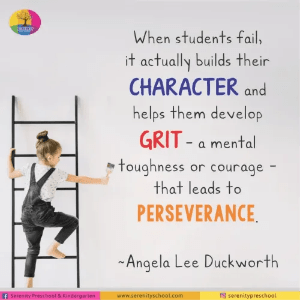
Angela Duckworth, Ph.D defines grit as a "child's perseverance and passion for long-term goals, coupled with a powerful motivation to achieve their respective objective." Duckworth has been studying grit and the behavior of students. Duckworth found that grit, not intelligence or academic achievement, was the most reliable predictor of a positive outcome.
Paul Tough "agreed that developing skills like "grit, perseverance, self-control, optimism, gratitude, social intelligence, zest, and curiosity" are more important than IQ. ("How children Succeed," Paul Tough) He has done research that shows parents who shielded children early from stress, had increased and boosted these traits.
Let your child find passion.
Give your child the time and space to find their passion. This can be hard, what drives them may not be what has driven you. Be supportive and encouraging, a passion will motivate them. Motivation will help them engage and work hard to feel successful.
Let your kids get frustrated.
 This may seem counter productive, because you want to help them and protect them from struggles. Allowing your child to experience frustration and sadness helps them develop resiliency, which builds grit. Pay close attention to your child, don't let them quit at the first sign of struggle or discomfort. Learning how to do something or become proficient is a skill. This skill brings great satisfaction and happiness when they can look back at how they accomplished something. Think about your child learning to walk, how many times did they fall on their bottom and you encouraged them to get back on their feet. This same scenario happens over and over in our lives. It's is the ability to get back up and try again that builds grit.
Model a growth mindset.
Carol Dweck, Standford professor, "found that people with 'growth mindsets' are more resilient and tend to push through struggles because they believe that hard work is part of the process and they do not believe that failure is a permanent condition." (Angela Duckworth, quoted Dweck in TED talk May 2013)
A growth mindset, is being open to the possibilities to new things, which can be a new process, a skill, a new food, or an adventure. A growth mindset is more about the process of learning and not about being smart. If we can remain positive about the mistakes kids make, they will start to believe that mistakes and failing are part of learning.
A growth mindset, is being open to the possibilities to new things, which can be a new process, a skill, a new food, or an adventure. A growth mindset is more about the process of learning and not about being smart. If we can remain positive about the mistakes kids make, they will start to believe that mistakes and failing are part of learning.
Brainstorm Together.
Brainstorming is an important part of the learning process. As parents we can help encourage our kids to continue and not give up. An aspect of brainstorming is allowing your child to feel like it was their idea or to take ownership. Resiliency and perseverance is developed when children learn that difficulty does not mean they are stupid, but part of the process of learning.
Become a Gritty Parent.
The most effective way to teach kids grit is to watch their parents being Gritty. It goes back to the idea that kids do as we do and not what we do. If our kids watch us being resilient and persevere they will see that and emulate it. Show kids that sometimes you struggle, and have challenges. Then show them how you work through the problems even when things can be scary. One of the greatest lessons I learned from my dad is how to figure out how to fix something. My dad wasn't a professional handy-man, but with some research and help from the hardware employee he could fix just about anything. As a home home-owner, things break or as I want to do home improvement projects, it brings me peace that I know that I can figure it out. This is because as my dad was figuring it out, I was right beside him, learning from him. This also taught me how I want to act. In the face of difficulty he easily got frustrated, I on the other hand, work hard to remain calm and keep trying with a positive attitude. If at first you don't succeed, its the ability to continue and try again that shows grit.
True Grit.
True grit is failing and having the ability to bounce back. This one of the greatest lessons we can teach our children. As we learn grit we will only become better parents and members of society.
Below is a excerpt from Angela Duckworth, Ph.D. Ted Talk, May 9, 2013


